ARTICLES
Articles about Kamil Khanlarov by art historians and critics
HIS WORLD OF COLORS
The People’s Artist of Azerbaijan, Kamil Khanlarov, has played a special role in the formation and development of the Azerbaijani painting school, as well as in training generations of professional Azerbaijani artists. This year marks his 110th anniversary.
Kamil Ali Abbas oglu Khanlarov was born in 1915 in Baku. Showing an early interest in art, he studied at the Azerbaijan State Art College named after Azim Azimzade from 1931 to 1935, mastering the secrets of the craft. The outbreak of the Second World War limited his opportunities for higher education, yet he continued to develop his skills and artistic abilities through intensive observation and active creative exploration, as can be clearly seen in his works.
In 1939, K. Khanlarov became a member of the Union of Artists. His extensive creative and pedagogical work was highly appreciated, and he was awarded the honorary titles of Honored Artist (1964) and People’s Artist (1992). His works are kept in numerous museums, galleries, and private collections in Azerbaijan. He held multiple personal exhibitions in Baku (1961, 1966, 1985, 1995, 2010). Khanlarov also taught at the Azerbaijan State Art College named after Azim Azimzade for many years (1938–1985), inspiring young artists to master the subtleties of art.
Kamil Khanlarov distinguished himself in various genres of easel painting as well as in theatrical set design. His work demonstrates a masterful use of classical Azerbaijani miniature painting traditions.
Looking at his creative world, one can particularly notice his landscapes, characterized by lyrical emotion, expert use of color, and artistic interpretation of the subject. His dedication to the landscape genre reflects his deep love for his native Azerbaijan. He traveled extensively across the country, including Absheron, Nakhchivan, Ordubad, Culfa, Sharur, Karabakh, Shusha, Zagatala, Lankaran, Astara, and other regions, capturing the enchanting nature in his unique artistic vision. Among these works are “Zagatala Mountains” (1946), “Astara” (1955), “Talysh Mountains” (1956), “Around Shusha” (1957), “Shusha” (1964), “Evening in Bilgah” (1964), “On the Banks of the Aras” (1965), “Sharur Valley” (1968), “Southern Border” (1972), “View of Murovdagh” (1972), “Culfa. On the Banks of the Aras” (1973), “Landscape. Shusha” (1983), “Ceyranbatan Lake” (1987), “Winter in Ordubad,” “Ilanly Mountain,” and others.
Among his works, the landscapes dedicated to Shusha attract special attention. Here, the artist masterfully conveyed the beauty of the Chidir plain with deep affection. Such works inspired by his love for the homeland can serve as examples for modern young artists. Many Azerbaijani artists have also undertaken creative journeys to Shusha, highlighting their connection to the region.
Khanlarov’s landscapes are not only visually striking but also convey a delicate, contemplative mood. This can be seen in his choice of subjects such as Sharur Valley, the Aras River, and surrounding mountains, depicted in subdued and reflective tones. In works like “On the Banks of the Aras” (1965), “Sharur Valley” (1968), “Southern Border” (1972), and “Culfa. On the Banks of the Aras” (1973), the artist subtly expresses his civic stance.
In “Ilanly Mountain,” he depicted the legendary mountain in Nakhchivan, associated with Noah’s Ark, in a strikingly memorable way. “Winter in Ordubad” is the only winter landscape in his oeuvre, showing local women in traditional attire on a snowy path, enhancing the romantic charm of the scene. Other notable works include “Ordubad Mountains.”
Khanlarov also created narrative paintings reflecting lyrical feelings and humanist values, such as “In the Field” (1963), “Family” (1965), “In Azerbaijani Fields” (1967), “After Work,” and “At the Spring.”
In portraiture, he created works such as “Little Dilara” (1951), “Dilara” (1953), “The Elder” (1954), “Mammadali, People’s Artist of Shaki,” “Portrait of Rovshan,” “Portrait of Sattar Bahlulzade” (study), “Portrait of Haji Zeynalabdin Taghiyev,” and “Portrait of Enver Pasha.” His portraits of historical figures like Haji Zeynalabdin Taghiyev and Enver Pasha are particularly noteworthy, immortalizing them with rich colors and skillful execution.
The still life “Oriental Still Life” holds a special place in his work, executed with artistic and technical mastery. The composition includes national household items against a backdrop of traditional fabric, with a color scheme skillfully balanced across yellow, red, turquoise, and blue.
In 1961, Khanlarov traveled to Czechoslovakia, expanding his creative horizons and returning with works distinguished by meaning and content. His paintings from this trip include “Street in Prague,” “Square in Karlovy Vary,” “Golden Street,” “Tower in Prague,” and “Monument to Jan Hus,” demonstrating mastery in theme, color, and technique.
He also contributed to film, providing costume sketches for “Villagers” (1937), working on costumes for “Fatali Khan” (1945), and designing the stage for Abdulla Shaig’s play “Nushabe” (1947).
Devoting his life to the development and promotion of Azerbaijani art, Kamil Khanlarov, as an inspired painter and mentor to many prominent artists, will always be respectfully remembered in the history of Azerbaijani art.
Asad Quliyev
Member of the Union of Artists, Art Critic
Sources
- Azerbaijan newspaper — article on Kamil Xanlarov (31.10.2025): azerbaijan-news.az
- Azerbaijan National Library — article on Kamil Xanlarov: anl.az
- Wikipedia — article on Kamil Xanlarov: az.wikipedia.org
TALENT OF THE GREATMASTER
The formation and flourishing of modern Azerbaijani art are inextricably linked with the creative potential of artists from many generations, representing different stages of its development. Therefore, when speaking about an artist of such range as Kamil Khanlarov — a patriarch of painting — it is difficult to overestimate the significant contribution he made to the treasury of fine arts of the Republic.
He was a highly professional and original artist who spoke about his land and people with great love, possessing a recognizable style, a distinctive manner, and an emotionally rich palette.
The fruitful artistic path of Kamil Khanlarov is vividly illustrated by a large number of his works and several solo exhibitions. His paintings are preserved in museums of our republic as well as abroad. The best of them have been reproduced in fundamental works on the history of fine arts, catalogs, and magazines that worthily represent the national art of Azerbaijan.
Kamil Khanlarov’s art, realistic and kind in spirit, stems from the uniqueness of national roots — namely, classical Azerbaijani miniature painting. His best works are distinguished by artistic maturity, harmony of color, and a deep, all-encompassing love for the beauty of his native land.
As a student of the Baku Art School in 1932, he exhibited his first painting “Meeting in the Village.” The debut of the young artist was successful and did not go unnoticed. The small canvas, filled with keen attention to the rural theme — which became a defining and dominant subject throughout his future career — truthfully depicted the “sprouts” of new life in the post-revolutionary Azerbaijani countryside and the enthusiasm of its peasants.
Upon graduation, he painted his diploma work “Nomads,” which determined his future creative path. It reflected his perseverance, diligence, and aspiration to master the fundamentals of his beloved art. The painting remained memorable for its liveliness, naturalness of the figures, and spontaneity of the plein air.
In the pre-war years, Khanlarov often turned to historical and revolutionary themes. One exception was his genre painting “Collective Farm Market in Ganja,” touching for its simplicity and sincerity. Around the same period, he painted “Peasant Uprising in Tovuz.” Both paintings are closely connected to nature — with accurately chosen characters, color, and a free manner of painting. “Peasant Uprising in Tovuz” reveals his clear realism and understanding of the depicted event. The figures of the peasants, ready for revolt, are vivid and full-blooded. The young artist’s sharp eye captures tension and dynamics with great insight.
His versatility is also evidenced by his work as a production designer for the films “Kendliler” (1937) and “Fatali Khan” (1945), as well as the stage design for Abdullah Shaig’s drama “Nushaba” (1947).
At the First Congress of Azerbaijani Artists in 1939, Kamil Khanlarov became a member of the Union of Artists of Azerbaijan.
During the war years (1941–1945), he painted a number of historical works and portraits that became integral parts of the permanent exhibition of the Nizami Museum of Azerbaijani Literature, opened in 1940 for the 800th anniversary of the great poet and philosopher Nizami Ganjavi. His famous paintings “Mazdak Before Execution,” “The Troop of Javanšir,” “The Expulsion of the Sasanians,” and “Abu Ulla Reads a Qasida to Shirvanshah Manuchehr in the Presence of Shirvani and Feleki” became milestones in his art and his artistic “calling cards.” These works show his devotion to historical truth, careful composition, preparatory sketches, and mastery of the final canvas.
Among his creations are portraits of renowned medieval cultural figures such as “Sultan Muhammad,” “Aga Mirek,” “Gatran Tabrizi,” “Nizami Ganjavi,” “Javanšir,” “Nasimi,” and others.
Even in his early works of the 1940s–1950s, he appears as an artist of rich talent and lyrical perception, with a mature and distinctive painting manner.
Khanlarov’s landscapes, decorative in color and spectacular in composition, summarize his long creative exploration of rural themes. His artistic process rejected imitation of nature and always sought monumentality and imagery. Such are “Zakatala Mountains,” “View of Kopet Dag,” “Autumn Plowing,” “Absheron,” and many others — built on bold color contrasts of blue, azure, and lilac tones.
An important milestone in his career was his trip to Czechoslovakia in the early 1960s. The Prague series — including “Loren Bridge,” “Monastery of St. Ludmila,” “Old Town Square,” “Prague Morning,” and “Prague” — is plein air, fresh, and emotionally expressive. Gentle in tone are “Evening in the Mountains,” “Around the Tatras,” “Mala Strana Tower in Prague,” and “Monument to Jan Hus.”
Tracing Khanlarov’s long artistic journey, one senses a turning point at the boundary of the 1960s–1970s, marked by increased decorativeness of color — a characteristic feature of his later work. His best canvases of this period are dominated by rich contrasts and jubilant color — sometimes local but always harmonious and meaningful. His affinity for the melodic generosity of miniature painting, from which he always drew inspiration, is especially evident in works like “On the Southern Border,” “Norashen Valley,” “Ilanly Dag,” “Dawn in Bilgah,” and “Old Absheron.” To this period also belongs the vividly colored “Oriental Still Life,” where blue, red-yellow, and turquoise hues vibrate in harmony.
Khanlarov was also drawn to genre motifs and the expressiveness of plastic language. Paintings such as “Family,” “Lankaran Vegetable Growers,” “Tea Leaf Pickers,” “At the Site,” and “Harvest Festival” reflect the same themes but tend toward more generalized artistic language — monumental yet lyrical and celebratory.
Despite his focus on landscapes, Khanlarov often returned to historical subjects. Notable examples include the triptych “In the Foothills of the Caucasus,” “Reception of the Russian Envoy by Fatali Khan,” and “Meshadi Azizbekov Among Peasants.”
In his studio, among many works, an empty white canvas always stood on the easel — a symbol of the eternal search for beauty, joy, and hope. Numerous personal exhibitions of Kamil Khanlarov revealed new facets of his kind and noble creativity. His works were exhibited in Austria, Hungary, Romania, Germany, Egypt, Iraq, Canada, Syria, Norway, France, Finland, Japan, Iran, Afghanistan, Turkey, and Poland.
A kind friend, a man of sensitive and trusting soul, and a connoisseur of poetry — the artist Kamil Khanlarov passed away in 1996 at the age of eighty. Through his inimitable works, he joined eternity, leaving an indelible mark in the history of Azerbaijani fine art.
Ophelia Mirzazade
Ph.D. in Art History
THE KHANLAROVS — A DYNASTY OF BAKU BEYS
The Khanlarovs are one of the ancient and notable titled noble families of Azerbaijan — a non-granted and non-ruling khan family that possessed significant property and wealth. In the early 18th century, the Khanlarov family became related to the ruling dynasty of the Baku Khans, who reigned from 1747 to 1806. In the first quarter of the 19th century, after the annexation of Northern Azerbaijan to the Russian Empire, the family was recorded under the surname “Khanlarov.” It is a coat-of-arms-bearing family.
The family coat of arms of the Baku bey family Khanlarov is registered under No. 004 in the Azerbaijan Historical and Genealogical Society.
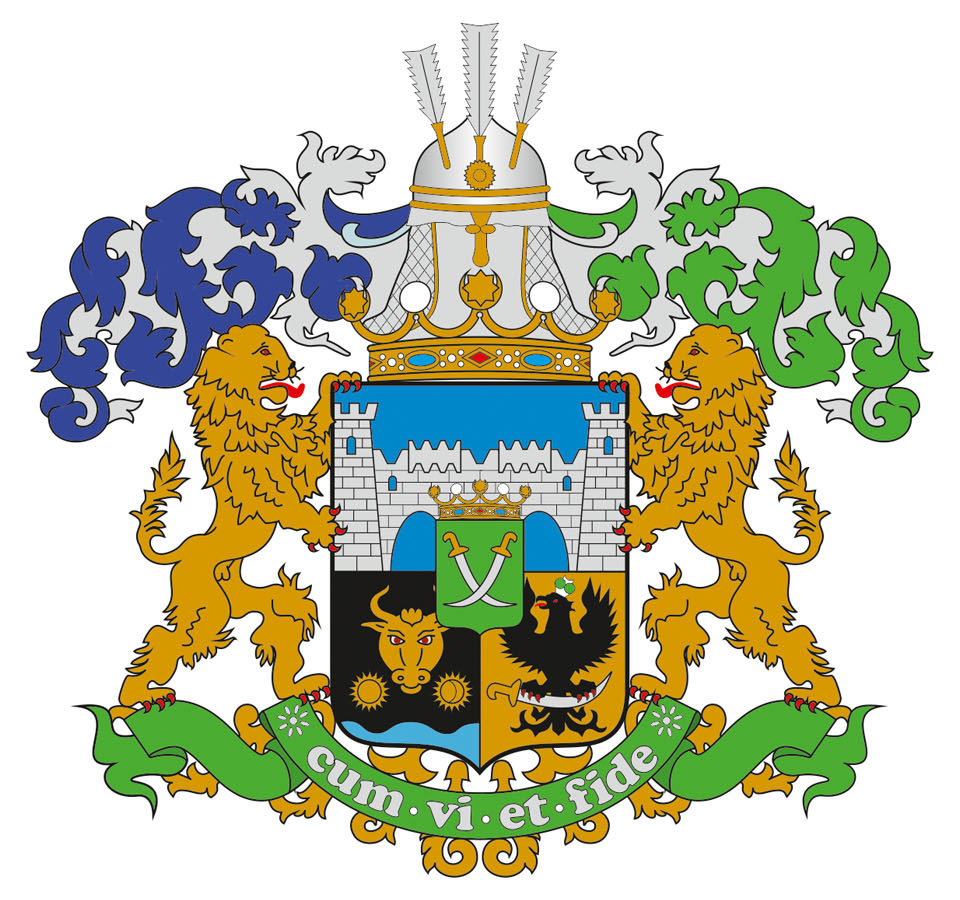
Khanlarov Family Coat of Arms
Description of the coat of arms:
“The shield is divided into three parts, crosswise and lengthwise from below, with a small shield in the center, where in a green field there are two crossed silver oriental sabers with golden hilts pointing downward. The small shield is crowned with a golden bey crown. In the upper azure field, a silver fortress wall with two open gates. In the right (heraldically left) black field with an azure wavy base — a golden bull’s head, accompanied below by two golden celestial symbols. In the left golden field — a black single-headed eagle with red eyes, tongue, and claws, holding a silver oriental saber with a golden hilt. The eagle is crowned with a khan’s crown. The shield is topped with a golden bey crown, from which rises an oriental silver helmet with three similar feathers. The mantling: right — azure with silver; left — green with silver. The shield supporters are two golden lions with red eyes, tongues, and claws. Motto: CUM VI ET FIDE (“With Strength and Faith”) — in silver letters on a green ribbon.”
Explanation of the coat of arms:
The two crossed oriental sabers forming the letter “X” indicate the military spirit of the family, while their downward direction emphasizes peace, restraint, and composure. The fortress symbolizes the Baku fortress and its paired gates, above which were the city symbols. The gates also marked the beginning of the route to the northern regions of the country, particularly to the Quba province, where the Khanlarovs owned land, settlements, and other property. The bull’s head indicates kinship with the Baku khans and symbolizes fertility, labor, and perseverance. The eagle crowned with the khan’s crown symbolizes the idea of active life, power, magnanimity, and foresight — reflecting loyalty to firm authority and readiness to defend their interests. The azure wavy stripe above the bull’s head symbolizes the Caspian Sea. The Hanlarov family is one of the three families that came to Icherisheher when Baku was just beginning to form as a city. The bey family of Hanlarovs traces its origin to Iskender-bey, the patriarch of the dynasty, who lived in Baku in the late 17th – early 18th centuries.
Prof. Chingiz Qajar
Full Member of the National Academy of Sciences of Azerbaijan
Sources
- Khanlarov — Dynasty of Baku Beys, OurBaku: ourbaku.com
- Web version of archival page — ANL Library, page 89: web2.anl.az
- Wikipedia — article on Chingiz Qajar: en.wikipedia.org